Just Enough NLP with Python
| Author: | Andrew Montalenti |
|---|---|
| Date: | 2012-10-26 |
How this was made
This document was created using Docutils/reStructuredText and S5.
It is the introductory NLP course given by Parsely, Inc. to the newest generation of Python hackers.
Simplicity begets elegance.
Meta Information
Me: I've been using Python for 10 years. I use Python full-time, and have for the last 3 years.
Startup: I'm co-founder/CTO of Parse.ly, a tech startup in the digital media space.
E-mail me: andrew@parsely.com
Follow me on Twitter: @amontalenti
Connect on LinkedIn: http://linkedin.com/in/andrewmontalenti
Parse.ly
What do we do?
How do we do it?
Complex Media
Male-focused media company started by Mark Ecko, American fashion designer and entrepreneur.
Huge monthly traffic numbers, lots of readers across the world.
Early adopters of Parse.ly.
Eye Disease
Progressive outer retinal necrosis.
Also known as Varicella zoster virus retinitis (VZVR), it is an aggressive, necrotizing inflammation of the eye's retina caused by herpes varicella zoster virus.
So, a question
Why was I researching eye disease on a Saturday to debug a customer problem?
Answer
Progressive
Outer
Retinal
Necrosis
ANSWER
P O R N
Lesson Learned
Customer Metadata is Hard (See my talk on crawling/metadata later today)
Topic Ontologies are Hard (See Didier's Wikipedia talk later)
Thorny problems in NLP persist: disambiguation, overfitting
NLP may not be the answer; consider IR
Parse.ly is even undergoing an NLP -> IR shift in approach
That said, NLTK keeps getting better
NLTK Hello, World
>>> import nltk
>>> msg = "Hello, World!"
>>> nltk.wordpunct_tokenize(msg)
['Hello', ',', 'World', '!']
Why is NLTK a Pythonic library?
>>> len(dir(nltk))
355
>>> fd = inspect_module(nltk)
>>> fd.items()
[('class', 172), ('function', 107), ('module', 48), ('other', 28)]
Here's inspect_module for reference
import nltk
import inspect

def inspect_module(module):
    fd = nltk.FreqDist()
    inspections = ["function", "module", "class"]
    for item in vars(module).itervalues():
        matched = False
        for inspection in inspections:
            if getattr(inspect, "is%s" % inspection)(item):
                matched = True
                fd.inc(inspection)
        if not matched:
            fd.inc("other")
    return fd
Batteries Included
With more than 100 classes and 100 functions in the root nltk module, nltk certain adheres to "flat is better than nested"
However, in the best Pythonic style, the flattened namespace is also neatly organized into nearly 48 submodules, of which many contain sub-sub-modules. Therefore, it also respects "namespaces are one honking great idea"
Practicality beats purity
Although NLTK is, in name, a "natural language toolkit", it also includes some generally useful modules that are notably missing from Python Stdlib.
I've already used one of these, nltk.FreqDist, which is a generic and Python "frequency distribution" class. It is actually dict-like, which means it supports the full dictionary protocol, but adds a few more functions.
The keys are labels and values are integers representing number of occurrences of each supplied label. You increment labels with fd.inc().
Practicality: HTML cleaning
nltk.clean_html is a nice HTML-stripping function.
>>> nltk.clean_html("""
    <p>This is some article text
    with <a href='http://google.com'>
    a link to Google</a></p>""")
'This is some article text with a link to Google'
Practicality: Tree data structure
nltk.Tree is a powerful abstraction for grouping trees and subtrees.
Each Tree contains leaves and subtrees. Leaves are simply literal values, but subtrees are treated specially.
Further, trees can have arbitrary node properties. Finally, Tree instances can be constructed either using Python procedural code or a simple text DSL implemented by the Tree.parse class method.
Syntax parse tree example
John hit the ball.
JOHN hit the ball.
john HIT the ball.
john hit THE BALL.
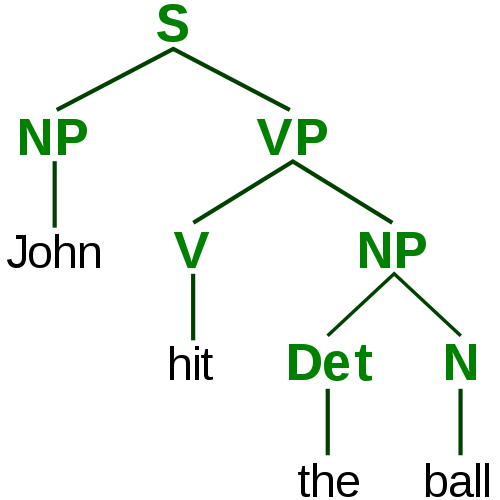
Syntax parse tree example
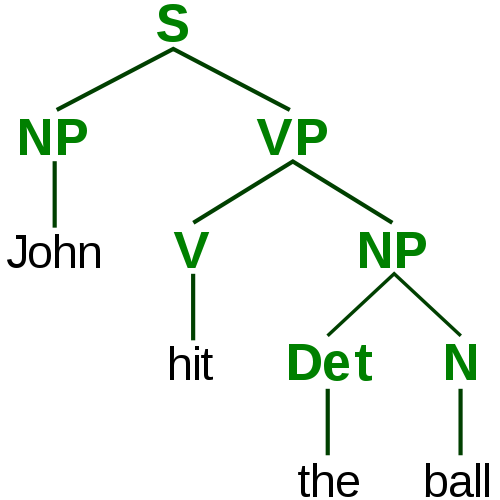
Syntax parse tree example
Tree example: parsing
>>> Tree.parse("""
(S
    (PERSON Herman Cain)
    runs for
    (POSITION president of the
        (COUNTRY United States)
    )
)""")
 Tree('S', [Tree('PERSON', ['Herman', 'Cain']), 'runs', ...
Tree example: printing
>>> print tree.pprint(margin=40, nodesep=" ->", parens=["", ""])
S ->
    PERSON -> Herman Cain
    runs
    for
    POSITION ->
        president
        of
        the
        COUNTRY -> United States
Tree example: drawing!
>>> tree.draw()
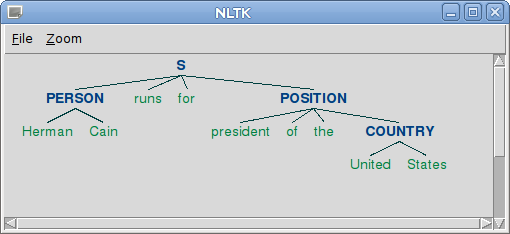
A taste of what's to come
>>> tree = entities("""Hermain Cain runs for
president of the United States""")
>>> print tree.pprint(margin=40, nodesep=" ->", parens=["", ""])
S ->
    NE -> Herman/NNP Cain/NNP
    runs/VBZ
    president/NN
    of/IN
    the/DT
    NE -> United/NNP States/NNPS
Text and TextCollection
One last set of data structures to be aware of are implemented in the nltk.Text and nltk.TextCollection classes.
A Text is nothing more than an in-memory data structure of a variety of a collection of tokens, with the ability to do quick text analyses such as term frequency, collocation, similarity, and simple regex-based searching.
A TextCollection is a grouping of Text instances that allows you to do corpus-wide calculations (such as term frequency, inverse document frequency, and yes, tf/idf!)
Text example
>>> t1 = nltk.Text(nltk.word_tokenize("""
    Barack Obama is president of the
    United States. Mr. Obama was elected
    in 2008."""))
>>> t1.count("Obama")
2
TextCollection example (1)
>>> t2 = nltk.Text(nltk.word_tokenize("""
    Barack Obama is giving a speech on Iraq tomorrow"""))
>>> t3 = nltk.Text(nltk.word_tokenize("""
    Barack Obama's speech illustrates the
    president's goal to leave Iraq"""))
>>> col = nltk.TextCollection([t1, t2, t3])
TextCollection example (2)
>>> col.vocab().items()[0:4]
[('Obama', 4), ('Barack', 3), ("'s", 2), ('Iraq', 2)]
>>> col.tf("Barack", t1)
0.066666666666666666
>>> col.tf("Obama", t1)
0.13333333333333333
>>> col.idf("Obama")
0.0
>>> col.idf("Iraq")
0.40546510810816438
>>> col.tf_idf("Obama", t1)
0.0
>>> col.tf_idf("Iraq", t2)
0.045051678678684932
>>> col.collocations()
Barack Obama
Quick note on Text/TextCollection
Though these classes are good for illustration purposes, I find this to be one of the less polished parts of NLTK.
For more formal support for texts and text collections, one should use Solr in production. I've considered experimenting with Whoosh (basically, "a Solr in Python," but simpler/less scalable) but never found a good reason to avoid simply loading text documents into Solr.
Rule vs. Data-based Corpus Linguistics
Part of the principle behind NLTK is that 100% rule-based language processing has failed to produce the results necessary for large-scale NLP needs.
NLTK's approach is to take the best of the rule-based world (parse trees, syntactic decomposition, tagging) and combine it with the lessons learned by the information retrieval community. That is, often data can inform models better than cleverness.
Practicality wins again: nltk.data
The nltk.data module offers access to a slew of off-the-shelf models that are widely used in academia, and is extensible so that you can add your own. The data tends to be stored in high-speed disk indexes (e.g. cPickle files) so that performance is acceptable as long as fast I/O is available.
import nltk
nltk.download()
On the NLTK menu (1)
So, we have seen that NLTK provides some basic utilities that will likely make NLP easier, such as trees and statistical data structures. What else does NLTK offer?
Much more than you might expect. Here are some highlights:
- nltk.tokenize: a variety of tokenizers using fast, rule-based algorithms. These are familiar to users of Lucene/Solr -- there are implementations here of e.g. Punkt, Treebank, and simpler approaches.
- nltk.stem: a variety of stemmers using rule-based and data-based algorithms. You'll find familiar ones like Porter and Snowball here
On the NLTK menu (2)
The following modules are really the core of NLTK:
- nltk.grammar: support for context-free grammars (CFGs) which are used in many rule-based systems. Interestingly, CFGs are very much used in computer science theory and programming language design.
- nltk.tag: after tokenizing text, you may want to annotate it with metadata that helps with understanding (such as parts of speech). The tag module is solely focused on this task, with classes that help with tagging and retagging tokens, such as Brill and Regexp based taggers.
- nltk.chunk: after tagging text, you may find it appropriate to "chunk" the text in order to gain meaning beyond the single-word level. This is particularly handy in information extraction / entity identification.
On the NLTK menu (3)
Finally, NLTK provides some modules that go beyond actually processing text and onto analyzing large amounts of text for meaning. These include:
- nltk.classify: offers feature-based classifiers such as NaiveBayesClassifier and MaxEntClassifier. These are not highly scalable implementaitons, but they are good enough for testing hypotheses and could be made to scale if needed.
- nltk.cluster: offers standard algorithms for grouping documents using e.g. the vector space model, k-means, and ways of visualizing these clusters.
On the NLTK menu (4)
- nltk.collocations: offers simple finders for ngram collocations, e.g. Barack occurs-frequently-with Obama
- nltk.featstruct: provides data structures for representing "features" of parsed language constructs. This is often used for "second-pass" filtering of noisy parts of your model.
- nltk.corpus.reader.wordnet: a simple wrapper for the powerful Wordnet dictionary/thesaurus.
Other options for Python NLP exist
And other options for NLP generally exist
Brief Interlude for Questions?
Next, we dive into doing entity extraction with NLTK. Any questions for now?
Entity Extraction
What is it, why do we need it?
NLTK has a default NER algorithm
from nltk import ne_chunk, pos_tag, word_tokenize

def entities(text):
    ne_chunk(
        pos_tag(
            word_tokenize(text)))

>>> print entities("Steve Jobs created our Apple iPads").pprint()
(S
    (PERSON Steve/NNP)
    (PERSON Jobs/NNP)
    created/VBD
    our/PRP$
    shiny/NN
    (PERSON Apple/NNP iPads/NNP))
Good NER is hard
So, despite this system's fancy model, including a whole lot of gold-standard data, it still managed to make some mistakes. It considered "Steve" and "Jobs" to be two different people, and it wrongly considered "Apple iPads" to be a person.
However, perhaps it is being too ambitious? Can we make it detect "entities" regardless of whether they are geographic regions, people, or other classifications? Yes!
Binary NER
Binary NER is a simpler problem than "traditional" NER, though still hard.
def entities(text):
    chunks = \
        ne_chunk(
            pos_tag(
                word_tokenize(text)),
        binary=True) # binary only enables one type, "NE"
    return chunks

>>> print entities("Steve Jobs created our Apple iPads").pprint()
(S
    (NE Steve/NNP Jobs/NNP)
    created/VBD
    our/PRP$
    shiny/NN
    Apple/NNP
    iPads/NNP)
Better, but still not perfect
This time, Steve Jobs was properly identified as an entity, but the binary extractor did not pick up on Apple iPad.
However, let's think about language a bit. Our trained part-of-speech tagger didn't have a hard time detecting the proper nouns in the sentence. "Apple" and "iPad" were both considered proper nouns, just like "Steve" and "Jobs".
For an inclusive NE chunker, wouldn't we be well off to simply treat any proper nouns as entities? We can model this decision with NLTK.
RegexpParser for proper nouns
from nltk import RegexpParser

chunker = RegexpParser("""
NAME:
    {<NNP>+}
""")

>>> parsed = chunker.parse(pos_tag(word_tokenize("...")))
>>> print parsed.pprint()
(S
    (NAME Steve/NNP Jobs/NNP)
    created/VBD
    our/PRP$
    shiny/NN
    (NAME Apple/NNP iPads/NNP)
)
There we go!
On the right track
Perhaps we can do a combination of traditional NER and syntax rules?
Add a small show method to help
First, let's make the data easier to inspect.
def text2tree(text):
    chunks = \
        ne_chunk(
            pos_tag(
                word_tokenize(text)),
        binary=True) # binary only enables one type, "NE"
    # I don't normally do this, but it'll help :)
    def show(self):
        return self.pprint(margin=40, nodesep=" ->", parens=["", ""])
    # MONKEY PATCH
    chunks.show = types.MethodType(show, chunks)
    return chunks
Trees become entities
def chunk2entity(chunk):
    return ' '.join(leaf[0] for leaf in chunk.leaves())

def tree2entities(tree):
    # set comprehension, what the fuck up!?
    entities = {
        chunk2entity(chunk)
        for chunk in tree
        if hasattr(chunk, 'node')
    }
    # yea!
    return entities
Even easier to print
def p(text):
    print text2tree(text).show()
Unigram problems illustrated (1)
First names are valid named entities:
>>> p("Angelina just doesn't get Brad")
S ->
    NE -> Angelina/NNP
    just/RB
    doesnt/VBZ
    get/VB
    NE -> Brad/NNP
Unigram problem illustrated (2)
Capitalized unigrams lead all sentences:
>>> p("Expectation drops in Goldman's earnings")
S ->
    NE -> Expectation/NN
    drops/NNS
    in/IN
    NE -> Goldman/NNP
    earnings/NNS
Unigram problems illustrated (3)
Many seeming unigram entities are just things:
>>> p("Apple farms reduce output")
S ->
    NE -> Apple/NNP
    farms/NNS
    reduce/VB
    output/NN
Contrived examples (1)
>>> p("Brad Pitt and Angelina Jolie broken up")
S ->
    NE -> Brad/NNP Pitt/NNP
    and/CC
    NE -> Angelina/NNP Jolie/NNP
    broken/NN
    up/IN
Contrived examples (2)
>>> p("Barack Obama gave a speech on the Iraq War")
S ->
    NE -> Barack/NNP Obama/NNP
    gave/VBD
    a/DT
    speech/NN
    on/IN
    the/DT
    NE -> Iraq/NNP War/NNP
Contrived examples (3)
>>> p("Sachin Kamdar is CEO of Parsely")
S ->
    NE -> Sachin/NNP Kamdar/NNP
    is/VBZ
    CEO/NNP
    of/IN
    NE -> Parsely/NNP
Back to reality
Based on these contrived examples, you could draw lots of wrong conclusions.
It seems like we're doing a good job, but we're just getting lucky.
Headlines (and full text) have a lot more going on than these intentionally simple sentences.
Ideas for improvement
- Get a better POS tagger
- Get a better chunker
- Use bigrams, trigrams, or 4-grams
- Choose tags to exclude/include
- Utilize corpus information (TF/IDF)
- Prebuild affinity indices (concordance/collocation)
- Leverage a taxonomy (e.g. Wikipedia)
- Tap into meta-information (categories)
- Navigate up in conceptual understanding (hypernyms)
- Use a search engine during NLP phase (fire boolean queries)
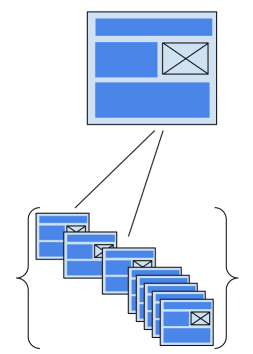
Single doc vs. corpus analysis
Keyword Colocation
What is it, why should you care?
Colocations Example
from nltk.collocations import TrigramCollocationFinder
from nltk.metrics import TrigramAssocMeasures
from nltk.corpus import webtext
from nltk.corpus import stopwords
stop_set = set(stopwords.words('english'))
stops_filter = lambda w: len(w) < 3 or w in stop_set
words = [word.lower()
            for word in webtext.words('singles.txt')]
tcf = TrigramCollocationFinder.from_words(words)
tcf.apply_word_filter(stops_filter)
tcf.apply_freq_filter(2)
tcf.nbest(TrigramAssocMeasures.likelihood_ratio, 4)
Stemming
What is it, why should you care?
Stemming Example
from nltk.stem import PorterStemmer
from nltk import word_tokenize

def publisher_text(pub_name, stem=False):
    if stem:
        stemmer = PorterStemmer()
        stem = stemmer.stem
    else:
        stem = lambda word: word
    textfile = open("data/%s.txt" % pub_name)
    words = (stem(word.lower())
                for headline in textfile
                for word in word_tokenize(headline.strip().replace(".", "")))
    return " ".join(words)
publisher_text("bloomberg")
Wordnet
What is it, why should you care?
Wordnet Example
>>> from nltk.corpus import wordnet
>>> senses = wordnet.synsets("newspaper")
>>> s = senses[0]
>>> s.hypernym_paths()
[[Synset('entity.n.01'),
Synset('physical_entity.n.01'),
Synset('object.n.01'),
Synset('whole.n.02'),
Synset('artifact.n.01'),
Synset('instrumentality.n.03'),
Synset('medium.n.01'),
Synset('print_media.n.01'),
Synset('press.n.02'),
Synset('newspaper.n.01')]]
>>> s.hyponyms()
[Synset('daily.n.01'),
Synset('school_newspaper.n.01'),
Synset('tabloid.n.02'),
Synset('gazette.n.01')]
Classification
What is it, why should you care?
Classification Example
>>> features = [(word, True) for word in word_tokenize(text)]
>>> classifier = nltk.data.load('classifiers/my_classifier.pickle')
>>> classifier.classify(features)
'pos'
How do I make a classifier?
NLTK includes a few basic classifiers out of the box.
Best option for building your own is japerk's nltk-trainer project.
Provides a CLI for creating classifier pickle files from corpora.
nltk-trainer example
$ python train_classifier.py
    --instances paras \
    --classifier NaiveBayes \
    --ngrams 1 --ngrams 2 \
    movie_reviews
...
Created in nltk_data/classifiers/movie_reviews_NaiveBayes.pickle
Classifier from Scratch
from nltk import word_tokenize
from nltk.stem.wordnet import WordNetLemmatizer
import nltk
lemmatizer = WordNetLemmatizer()
lemmatize = lambda word: lemmatizer.lemmatize(word.lower())
def get_words(pub):
    for line in open('data/%s.txt' % pub):
        for word in word_tokenize(line):
            yield word
def word_features(pub):
    words = get_words(pub)
    return {"contains(%s)" % lemmatize(word): True
                for word in words}
bloomberg = [(word_features("bloomberg"), "Bloomberg")]
apttherapy = [(word_features("popsugar"), "Apartment Therapy")]
feature_set = bloomberg + apttherapy
classifier = nltk.NaiveBayesClassifier.train(feature_set)
Classifier Results
>>> classifier.classify(word_features("apttherapy"))
"Apartment Therapy"
>>> classifier.classify(word_features("bloomberg"))
"Bloomberg"
I certainly hope so! But how about others:
>>> classifier.classify(word_features("mashable"))
"Bloomberg"
>>> classifier.classify(word_features("nbclocal"))
"Apartment Therapy"
Conclusion:
- Mashable content is "like" Bloomberg
- NBC Local content is "like" Apartment Therapy
An obvious improvement
We are using a Naive Bayes classifier in above example, but that performs pretty poorly when using single word-based features.
(But hey, at least we're lemmatizing.)
Better would be to use something like a bigram model or the NER from earlier.
Baby Turtles
Use your powers wisely, and always remember...

Magic Turtles!
It's turtles all the way down!

Tweet and Meet
What did you think?
Tweet @amontalenti with #pydata hash tag!
Rate this talk! http://bit.ly/rate-andrew
Connect on LinkedIn: http://linkedin.com/in/andrewmontalenti